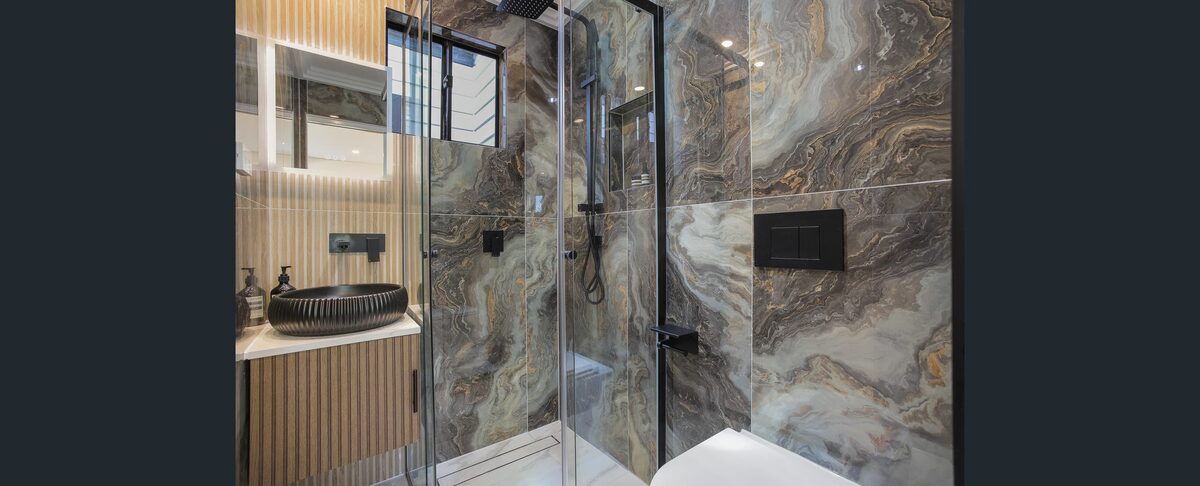
Waterproofing for your wet area
The useful starting point is a room-specific wet area waterproofing design, not a promise that tile and grout will keep water in place. Before you renovate, ask the responsible professional to identify the intended waterproofing system and what must be checked while it remains visible. Ask how it addresses water ingress into adjoining rooms.
| Owner’s question | Information to confirm |
|---|---|
| Which rules apply? | Building class, approval circumstances, applicable building code edition and local provisions. |
| What supports the finish? | The existing base, its condition and any preparation identified by the responsible trade. |
| How do the details connect? | Shower areas, drainage, junctions and service openings in the proposed design. |
| What happens before concealment? | Required checks, who arranges them and which records will be retained. |
Use these questions to identify gaps in the scope. They are a discussion aid rather than an installation specification. Technical decisions need to account for the actual construction and chosen products.
Which NCC applies in NSW?
The National Construction Code guidance says that the 2025 edition will be adopted on 1 May 2027. The current edition is the 2022 code, Amendment 2. Confirm which edition governs your particular approval and check the local variations. A publication date on a search result does not answer that project question.
The role of the Australian standard
AS 3740 concerns domestic wet areas. Ask the designer or certifier to identify the applicable compliance pathway and referenced edition rather than treating the standard’s name as a complete specification. The ABCB explanation for houses concerns Class 1 buildings and expressly excludes state variations; it is not the full local rule for every property.
A bathroom in a detached house and a room within a Class 2 building should not be assumed to have identical requirements. Ask the professional to identify the relevant Australian provisions for your wet area. This guide does not reproduce standard clauses or give universal membrane heights or thicknesses.
Checking a licensed waterproofer
Under the state licensing guidance, a contractor licence is required for residential waterproofing work valued over $5,000 in labour and materials, including GST. This is a regulatory threshold, not a construction price estimate or permission to use an unsuitable trade below that amount.
Use the official licence lookup and confirm the relevant category and any conditions. Check the waterproofing contractor’s entity as well as the attending tradesperson. Credentials do not replace the project’s design and installation records.
Membrane and substrate decisions before tiling
Ask who confirms that the substrate is suitable and that the proposed waterproof membrane is compatible with it. Changes to the base, drain or fixtures should be considered before surfaces are closed up. A penetration for a pipe and the junction between surfaces need to be addressed in the system details, not left as an assumption between trades.
Request a clear sequence: who prepares the base, who applies the treatment, who checks it and when tiling can proceed. Ask how the installed waterproof treatment will be protected during later work. A finished photograph cannot show the concealed layers or establish their condition.
If water damage or mould is already suspected, record the concern for assessment rather than assuming new finishes will resolve it. Ask how the proposed waterproofing compliance checks relate to the actual design and any existing condition.
Waterproofing certificate and inspection records
Agree compliance requirements and records before waterproof layers disappear behind finishes. Ask the certifier and contractor who supplies each record and what it identifies. Details of membrane systems, installation dates and photographs may support the record, but they do not automatically replace a required certificate or assessment.
If a proposed record is missing, ask the responsible party how the issue will be resolved before concealment. A sample form from another authority is not evidence that every job needs the same form.
Bathroom waterproofing questions
Has the state already adopted the new national code this October?
No. The current state guidance gives 1 May 2027 for adoption of the 2025 edition. Ask the certifier to confirm the edition and local variations applicable to your approval circumstances.
Does a licence check prove the installed membrane is compliant?
No. A licence check establishes credentials. Appropriate design, installation and any required checks are separate questions. Keep the relevant system and completion records as well as the contractor’s details.
Does every room need exactly the same details?
No. Building class, layout, the compliance route and local provisions matter. A diagram for a different property does not establish the correct treatment for yours.
Which documents should I request before the tiles conceal the work?
Ask the responsible contractor and certifier which system details, installation records, certificates and checks apply. Agree when they will be supplied and keep copies. There is no single document list that covers every scope.
For the applicable edition, use the official code guidance; for credentials, read the licensing requirements.
Agree the bathroom renovation scope
Discuss the room through Panadium’s room renovation service. Include design, trade coordination and records in the proposed scope. The pre-signing room questions address the agreement; this guide addresses the concealed treatment.